
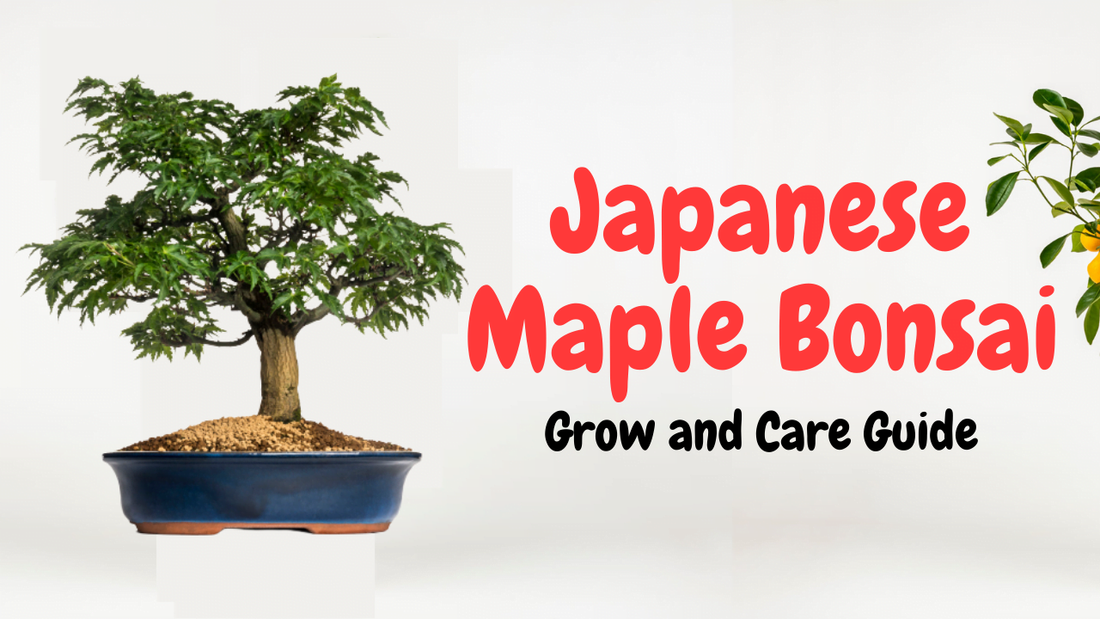
Japanese Maple Bonsai Trees: A Beginner's Guide to Growing and Caring
Are you dreaming of growing a Japanese maple bonsai at home? But are you also confused about how to plant a Japanese maple bonsai? Well, we got you covered, gardeners!
Many bonsai gardeners have a soft spot in their hearts for Japanese maples, and why not? They are the ideal specimen tree with gorgeous summer and fall foliage and cold-hardy roots. They have the most beautiful leaves that bonsai can have.
So, we are addressing your questions through this blog which will guide you on the growing, making, and caring for Japanese maple bonsai.
A tour of Japanese Maple Bonsai
| Common Name | Japanese Maple Bonsai |
| Botanical Name | Acer Palmatum |
| Native Area | Japan |
| Family | Aceraceae |
| Plant Type | Delicious Tree |
| Sun Exposure | Partial sun |
| Soil pH | Acidic 5.5 to 6.5 |
Japan is home to the deciduous Japanese maple tree. The tint of the leaves varies as the tree grows older. They begin with a green hue, then shift to an orange hue finally ending with a deep red hue. The tree's flexible branches make it ideal for bonsai training.
Japanese Maple bonsai tree will truly brighten up a room in a house or an office. How to make Japanese maple bonsai demands more dedication than planting any other plant.

Bonsai pots come in various shapes and sizes, and finding the right one for your bonsai tree is essential. You can find a variety of bonsai pots for sale online, including ceramic, plastic, and terra cotta options. Consider the material, size, and design when selecting a bonsai pot to ensure it meets the specific needs of your tree.
Japanese Maple Varieties for Bonsai
There are several Japanese maple cultivars suited for bonsai cultivation and training, and some of the most popular and well-known bonsai are mentioned below:
- Acer palmatum - Deshojo
- Acer palmatum - Arakawa
- Acer palmatum - Seigen
- Acer palmatum - Katsura
- Acer palmatum - Shishigashira
Growing Japanese Maples from Seeds
This question pops up in the head of every bonsai lover: how to grow Japanese maples from seeds? Yes, you certainly can grow it from seeds but the problem is elsewhere. The majority of the beautiful Japanese maple species available in nurseries are grafted, which means that the seeds they generate will not grow into the same tree.
Planting a Japanese maple seed will certainly result in a generic Japanese maple tree. It'll still be a Japanese maple, and it'll probably have red summer leaves, but it won't be as spectacular as the parent tree.
So, the natural question that pops ups after this is.
Is it impossible to grow Japanese maples from seed? The answer is definitely a 'No'. It is certainly not impossible to grow. Japanese maples are magnificent trees that consistently exhibit vibrant colors in the fall. And, because you never know what you'll get, the possibility is endless.
How to germinate Japanese maple seed?
In the fall, Japanese maple seeds are mature. When they're brown and dried and falling off the trees, it is the ideal time to collect them. You can plant both the seeds that fell into the ground and the seeds that you gathered from the maple tree.
It's critical to pre-treat Japanese maple seeds before sowing them on the ground.
- Place your seeds in a paper bag and store them in a cold, dark place during the winter if you wish to plant them outdoors in the spring.
Note: You can entirely skip storing seeds in a colder area and start treating the seeds right away if you plan to begin them in a pot.
- Start by breaking off the wings of the seeds.
- After that, soak your seeds for 24 hours in a container filled with water that is quite warm but not too hot to put your hand in. A bowl full of lukewarm water will do.
- Then, in a sealable plastic bag, ensure to combine the seeds with a little amount of potting soil.
- To stratify, poke a couple of holes in the bag for ventilation and place it in the refrigerator for 90 days.
- You can plant the seeds in a container or directly in the ground after 90 days.
Note:
- If you live where the winters are extremely chilly, you can skip the fridge and simply sow your seeds after they have soaked outside.
- The seeds will stratify just as effectively in the cold of winter.
After how to make Japanese maple bonsai , another question that adds to gardeners' query is how to care for my bonsai? Well, we will break it down and elucidate the process for your understanding.
Japanese Maple Bonsai Care
Japanese maple bonsai are reasonably easy to maintain and make excellent bonsai for both beginners and experts.
Light
Some bonsai species require more sunshine than Japanese maple bonsai.
It totally depends on the location because it will thrive if you have the perfect location to plant your Japanese Maple. Therefore being clever is vital. It's critical to give your maple bonsai the best possible protection from the sun's direct and destructive rays.
Japanese maple bonsai do best when placed in positions that receive early and evening sun. The sun is minimized in the late afternoon and evening, preventing sunscald, leaf burns and requiring less watering, just enough to keep the soil moist and cool. By placing your Japanese bonsai in a position with decent morning exposure but enough shade to prevent direct exposure, you can provide the amount of sunlight without causing sun damage.
Note on how to make Japanese maple bonsai:
A place with many tall shade trees is ideal for your Japanese Maples. These trees thrive in areas with dappled shade and filtered shade.
Soil
To flourish, Japanese maple bonsai requires a well-drained nutrient-rich soil with a 5.5- 6.5 pH range You can buy bonsai soil from our store as the soil mix is better because it is carefully prepared to assist bonsai tree growth. You can dodge waterlogging by adding a drainage layer of rocks or stones to the bottom of the pot of the Japanese maple bonsai tree.
Water
Like other bonsai plants, Japanese maples require a lot of moisture to survive. These maple trees may demand daily watering during the spring and summer months, but they will require substantially less water during the fall and winter months. You should keep it as the soil is uniformly moist but never flooded during the spring and summer.
It's best to water the Japanese bonsai tree before the heat arrives in order to guarantee that it has enough water to survive. Like any other plant, Japanese maple bonsai may suffer from nutrient deficiencies and root problems and die in the worst-case scenario if given insufficient water. The goal of watering your bonsai is to soak the soil completely.
Note on how to make Japanese maple bonsai:
- Japanese maples cannot withstand drought, which is why it is crucial to maintain soil moisture at a constant level.
- Just make sure to water the maple bonsai tree fully until the entire root mass is saturated.
- Avoid watering with calcareous water as the bonsai tree prefers a neutral or slightly acid pH value.
Temperature and Humidity
Japanese Maple Bonsai thrive in a bright, airy environment. Still, when temperatures reach 30 degrees Celsius or higher, it should be moved to a spot with indirect sunlight to avoid injuring the leaves. Even when trained as a Bonsai, it is frost resilient, although it should be protected when temperatures dip below -10 °C.
Japanese maple bonsai trees are best grown outside India and do not thrive well indoors like most bonsai. Although they are cold-hardy, they can only withstand brief periods of freezing temperatures and should be protected from harsh winter climates.
Fertilizer
Japanese maple bonsai require regular fertilization to produce vibrant and consistent new growth. Nitrogen (N), phosphorus (P), and potassium (K) are the three basic elements that should be present in the soil. Each component has a distinct function. Nitrogen stimulates leaf and stems growth, phosphorus promotes healthy root growth, and potassium is responsible for the bonsai plant's overall health.
We recommend you feed the tree with a nitrogen-rich fertilizer every two weeks during the spring since the buds require an extra push while they are in the blossoming stage. Switch to a nitrogen-free fertilizer in the fall and reduce the frequency of feedings to the Japanese maple bonsai tree.
Note on how to make Japanese maple bonsai:
- After repotting a Japanese maple bonsai, ensure not to feed them for a few weeks to let the delicate roots develop without being startled.
- To avoid unduly big leaves and internodes, avoid high nitrogen fertilizers for your maple bonsai tree.
Pruning
Pruning a Japanese maple bonsai tree on a regular basis is necessary for its attractiveness and health. Pruning your bonsai at the wrong time might cause serious harm or even death.
You should prune your Japanese bonsai twice a year. First, you can prune your bonsai tree in the middle of winter before any warmer weather hits in. Early February is the optimum time. You can do heavy training or corrective pruning now.
Note:
- Make sure to dodge pruning in late winter and early spring since it may lead your Japanese maple bonsai to grow quickly once the weather warms up.
- Pruning correctly will remove any ugly dead stems and will aid in teaching your bonsai plant to look like the shape and form you wish.
Early growth of your bonsai might cause frost damage and perhaps kill the plants. Following the hardening of the spring flush of growth, your maple bonsai needs a little second-pruning. It will remove any undesired wild growth from the tree and make it more adorable.
To prevent fungal diseases from entering pruning wounds, we recommend using a cut paste solution while cutting thick branches. Some fungal infections and illnesses are particularly dangerous to maple trees. Pruning new growth to one or two pairs of leaves is a good idea.
Pinching mature Bonsai with a careful ramification will keep the twigs thin. Make sure to remove the tiny tender tip of the shoot between the first leaf pair and the second leaf pair to keep the twigs from thickening.
Note: This procedure will weaken the tree in the long run and should be practiced carefully.
Leaf pruning
It is the process of removing all leaves from a plant throughout the growing season to foster a second, finer flush of growth. You should not perform it every year because it puts the bonsai tree under a lot of stress.
How to make Japanese maple bonsai includes removing all of the leaves but leaving the leaf stems alone. You can do it every year because partial leaf pruning is a gentler and less demanding trimming technique. Partial pruning does not necessitate removing all of the leaves. Remove the tree's largest leaves, tightly spaced, and those in the tree's strongest parts, and your work is done!
Potting and Repotting
The Japanese maple tree, like other bonsai, does not need to be repotted on a regular basis once it has established itself. On the other hand, Young trees benefit from repotting every year to help freshen the soil and trim the rootball. Japanese Bonsai pots will aid in achieving the bonsai look while also limiting the tree's development over time.
The optimal time to repot Japanese maple bonsai is right before the buds bloom in the spring. It will give the maple bonsai tree enough time to heal from the repotting before going into dormancy due to them football and winter.
Note on how to make Japanese maple bonsai:
- Japanese maples under the age of ten years must be re-potted every one to two years.
- We recommend you re-pot mature plants every two to three years.
- It is critical to remove up to half the length of the roots, especially on younger bonsai.
- The root structure of Japanese plants is shallow, allowing them to be planted in a shallow container while still allowing for rapid root growth. Avoid cutting any main roots as it will upset the primary system.
Common Problems, Pests & Diseases
As with any bonsai plant, the Japanese Maple is susceptible to many diseases and pests. Hence, it is essential to take proper care of this delicate plant. To do so, you must be aware of the following common problems and their solutions.
1. Mold spots on maple bonsai
It is a fungus that regularly harms and spreads rapidly. Also, there is a good chance that this fungus is to blame if you notice any brown or gray spots. If you ignore these warning signs, your plant may die.
Solution: In most cases, it is caused by overwatering Japanese maple bonsai. So, firstly, remove all infected parts of the plant. Then, take off any roots and leaves that are infected. Lastly, repot your plant using fresh soil.
2. Root rot in Japanese maple bonsai
The fungal pathogens pythium, fusarium, and verticillum cause root rot in Japanese maple trees. When the soil is saturated and overly wet for an extended period, these pathogens can survive and develop.
If the roots appear waterlogged or rotten, the pathogen is destroying the tree's roots. Also, it is possible to find reddish-brown cankers in the soil around the root system.
Solution: A Japanese maple bonsai need proper care to avoid disease and stress. While Japanese maple trees are hardy and adaptable to poor soil conditions, providing them with optimal growing conditions reduces disease and decline risks.
So, keep the soil moist, fertile, well-draining, and organically rich to support trees. Furthermore, Japanese maple trees prefer acidic conditions. Following these right conditions will prevent root rot and make your tree healthy and vigorous.
3. Maple bonsai leaves turning yellow
In the gardening world, yellow leaves are the most common problem. There are two main causes of this problem: overwatering and nutrient deficiency.
Solution: Reduce your watering frequency, or fix a potassium or nitrogen deficiency. Additionally, you can buy special soil for your plant deficiency. Moreover, a garden center consultant will be happy to help you with this information.
4. Sunburned maple bonsai tree
Sunburn on Japanese maple bonsai is easy to determine. The color of your plant will change, either turning yellow or white.
Moreover, browning leaves are a classic sign of overexposure to direct sunlight and sunburn. The plant will not die, but it will grow adversely.
Solution: Fortunately, the remedy is as simple as moving your Japanese maple bonsai out of direct sunlight. With this strategy and appropriate watering, your plant should quickly rebound.
5. Wilting or drooping bonsai leaves

This usually happens when your maple bonsai lacks water. It is especially true for large plants, which naturally need more water.
However, using a balance scale, you can determine if your bonsai plant needs water by underweighting it. If the pot seems light, the soil and roots are probably very dry.
Solution: If the soil in your pot is completely dry, you must moisten it first to ensure that the water reaches the roots. Also, a common mistake is drowning the Japanese maple bonsai right after a dry period. Giving too much water at once will end it most easily. Instead, water the soil peacefully and return to your normal watering rhythm.
Japanese maple bonsai: Pests
1. Pseudomonas syringae
Japanese Maple bonsai are most commonly affected by Pseudomonas syringae. This pest thrives on plants that have suffered damage previously. You can see spots on the leaves while the veins are darkened.
Solution: Pseudomonas syringae is commonly controlled by spraying bactericides. Some of these include copper compounds or other heavy metals, along with fungicides or other pest-control chemicals.
2. Aphids

Japanese maple leaves are often infested with sucking pests called aphids. It is difficult to identify these insects because they are relatively small. These insects take nutrients from leaves, causing them to fall off.
Moreover, a large number of leaves are usually affected at once as a result of this infestation. Thus, the canopy volume is reduced and leaf brilliance is minimized.
Solution: The best way to get rid of these pests is to spray cold water on them. Also, using flour prevents rapid reproduction and constipates pests. Additionally, you can spray the plant with insecticidal soap or horticultural oil.
3. Scale

This is a very common, and hazardous, pest of Japanese maple bonsai. Their tops are covered with a white armored crust, within which pests hide. On the stems and dark bars, their white armors are easy to spot. During extreme infestations, the leaves will start wilting before they should, the bark will dry, and the plant will die.
Solution: Scales ingest the toxic insecticide when they feed on sap and are killed. Three most commonly used systemic insecticides are effective against scale: acephate, imidacloprid, and dinotefuran. Mix the insecticide with water and apply it to the plant's base
Japanese maple bonsai: Diseases
1. Verticillium Wilting

It is one of the most concerning problems with Japanese Maple. The first symptom is discoloration of leaves. As it spreads, it will affect other healthy leaves on the same branch. If not removed immediately after noticing the symptom, the maple bonsai will not last long.
Solution: Once Verticillium wilt enters the plant, it cannot be cured. It's better to destroy small, easy-to-replace plants. Also, in the same area, don't plant another susceptible species, as the disease remains in the soil after removing the plant.
2. Anthracnose

During the rainy season, anthracnose is usually caused by high humidity. In this case, fungi attack the leaves and stems, causing spots. Despite pruning, the fungus will remain on pruned leaves and stems. Thus, they thrive before releasing spores. In other words, if one leaf of the Japanese Maple is affected, all other parts will be affected as well.
Solutions: Ensure that all infected plants in your garden are removed and destroyed. Remove dead wood from trees and destroy infected leaves. Spray your plants with a copper-based fungicide. However, be careful as copper can build up in the soil to toxic levels for earthworms and microbes.
3. Powdery Mildew

Almost all Japanese maple bonsais are affected by this disease. There is a white, powdery layer on top of the leaves due to mildew fungus. In humid areas or direct sunlight, powdery mildew is ten times more likely to occur.
Solution: Powdery mildew can be treated with baking soda. Mix 1 teaspoon of baking soda with 1 quart of water. Just make sure you spray plants thoroughly since the solution will only kill the fungus that comes in contact with it. Another good home remedy is milk spray.
When should I fertilize my maple bonsai tree?

You should feed your Japanese Maple Bonsai every other week during spring and summer with organic Bonsai fertilizer. In the fall, switch to a nitrogen-free fertilizer and reduce feeding.
Don't use quick-release fertilizer. Choose a controlled or slow release. To prevent shock, avoid feeding for several weeks after repotting.
Moreover, the Japanese Maple benefits from regular fertilizing. Yet, wait until your Japanese maple is one year old before fertilizing.
What is the best fertilizer for maple bonsai?
Nitrogen is one of the best fertilizers for maple trees. For the fast and healthy growth of maple trees, high nitrogen fertilizers are essential. The ideal fertilizer for maple trees consists of nitrogen, phosphorus, and potassium.
What soil is best for maple trees?
For Japanese Maple Bonsai to flourish, well-draining soil with a pH of 5.5 to 6.5 is necessary.
To make sure that your Japanese Maple grows well, plant it in a Bonsai soil mix. These soil mixes are specially formulated to make sure that your Bonsai grows well. The soil must cover the tree's roots. Besides that, the planter must have enough room for roots to grow.
From our store, you can buy bonsai soil as our soil mix is specially prepared to support bonsai tree growth. Furthermore, you can avoid waterlogging by adding rocks or stones to the bottom of your Japanese maple bonsai tree pot. Additionally, put shredded bark around your trees, preferably from hardwoods. This will keep the roots safe. You can speed up the tree's growth by adding coffee grounds to the soil.
When should I re-pot my maple bonsai?
It is best to repot maple bonsai in the spring, accompanied by root pruning, as roots can grow fairly quickly.
Moreover, it's OK to remove all the original soil when repotting as these species are pretty hardy. Also, you can cut up to 50% of the roots without weakening them.
You can use a soil medium that retains water, such as Aoki Blend or a 2:1:1 mixture of akadama, lava rock, and pumice. Generally, the particle size of soil should be about 3/16 inch (4mm) for medium and large trees, and slightly smaller for shohin trees.
Also, re-potting is necessary every 1 to 2 years for young Japanese maples under 10 years of age. The more mature plants should be re-potted every 2-3 years. Moreover, it is important to remove half the roots' length, especially for younger bonsai.
The roots of Japanese species are shallow, so they can fit into shallow pots, but they grow vigorously when planted in large pots.
Why is my Japanese Maple Leaves Curling?

Japanese Maple leaves can curl due to environmental factors such as too much sun or temperature stress. Additionally, improper watering, diseases, pests, and climate can cause curling maple bonsai leaves.
The following sections provide detailed information about each case. Additionally, you will get advice on how to fix the issue.
1. Underwatering Japanese maple bonsai
Underwatering is the first cause of curled leaves. Most of the time, this occurs in hot, sunny weather. Additionally, the hot wind makes things worse.
This will cause the leaves to curl inward and perhaps burn at the edges. However, you can still fix this problem if you notice it in time.
How to fix: Water the maple thoroughly, it should soak up the water. When the soil dries 1-2 inches deep, water again.
Lack of water often causes maples to twist. This rarely happens to trees with heavy roots. Also, potted maple trees tend to curl. Because hot weather dries out the potting soil fast. Hence, keep an eye on potting soil moisture or transplant maple outside.
2. Bonsai curled leaf due to disease
The first thing to mention here is anthracnose. We have seen in the above section that it's caused by different pathogens. Moreover, it poses a serious threat to young trees.
As soon as the disease begins, the leaves curl and have dark spots on them. Unless the disease is treated, the leaves will shrivel and fall off the young branches. It rarely kills maples. However, it can severely damage young trees.
How to fix: Make sure that the maple gets enough light. Also, make sure that the air is freely flowing around the tree. Consider transplanting it to a more open location if necessary.
To prevent further damage, spray the maple with a fungicide. Spray again after a while. Some cases may need multiple sprayings.
Also, stop overwatering maples. Additionally, don't direct your sprinklers toward the leaves if you have automatic watering.
3. A sudden change in temperature
Sometimes the daytime air temperature is really high, and the evening air temperature is very cold. As a result, leaves curl up to stay warm. Also, some leaves turn red or purple.
These sudden temperature changes usually occur in late spring or early summer. Those growing in pots or young maples are most susceptible. Although maples won't get serious damage, twisted leaves may stay for the entire season.
How to fix: In general, you shouldn't do anything, the tree will recover after a while. However, you can help your maple by watering it regularly. Then, water the maple with multipurpose liquid fertilizer. It will only take one watering with liquid fertilizer.
Additionally, you can shade the maple bonsai for a few weeks with a garden umbrella. It will be easier for your bonsai to recover from temperature stress if you reduce sun exposure.
4. Too much watering
Heavy rains or too much water can curl maple leaves. Also, this does not mean that Japanese maples will tolerate excessive watering.
If roots receive too much water, they lack oxygen and begin to rot. There will be yellowing and curling on the maple leaves.
How to fix: First thing, stop watering. Let the maple dry out for 2 inches before watering. You will get a bonsai tree back to normal if you notice the problem early and stop watering.
Also, you should transplant the maple bonsai if it lives in wet soil all the time. Use well-drained soil when replanting. Additionally, fill the planting hole with stones for drainage.
5. Too much sun
Too much sun is another reason. During the early spring, when leaves are unfolding, the weather can be cloudy. Then, all of a sudden, it gets sunny and hot. Normally, leaves that don't get direct sun curl inward to avoid getting burned.
Also, there can be browning of the leaf edges or brown spots in the center of the leaf. Usually, curling begins at the tips of the leaves. Moreover, it is more common for twisting to occur in hotter climates because of the strong sun.
How to fix: In this situation, the maple would benefit from shade. However, do not completely shade it, the maple still needs early morning sun. You can remove the shade when the curling stops.
Also, it is difficult to shade a maple that is already big. Only a little more water will help here but don't overwater the maple. It won't matter if the tree is damaged, it will eventually recover.
6. Using the wrong fertilizer
Your maple leaves may curl and droop if you have fed them a lot of mineral fertilizer. Nitrogen excess is the primary cause. As a result, the plant may grow vigorously, but its leaves and branches will not mature properly. This leads to soft, twisted leaves.
There is nothing you can do to change this situation. However, don't overfeed maple trees in the future.
The second scenario is when the soil lacks the necessary elements. This is about magnesium. For photosynthesis, this element is essential. Most soils have enough, but if the soil is very alkaline, it won't be there.
How to fix: Whenever maple leaves curl and turn yellow, but their green veins remain visible, it is probably chlorosis. With the help of acidifiers available at garden supply stores, you can acidify the soil. Also, use a slow-release multipurpose fertilizer no more than once a year on the maples. Do this at the beginning of the season.
7. Japanese maples infested with pests
Insects can also cause maple leaf curl. You might not even notice them, but if there are a lot of them, it can seriously damage your bonsai maple. Especially, your young maple bonsai tree is at risk.
There are two types of pests: branch-eating insects and leaf-eating insects. Among the most common insect pests are aphids. This insect sucks sap from leaves by attaching itself to its lower parts.
Second, there are spider mites. These tiny insects weave cobwebs on their leaves and branches on maple trees. They cause the leaves to curl as they stick to the tree.
How to fix: Spray horticultural oil or another insecticide on your maple tree to get rid of aphids. Single spraying of these insecticides will usually eliminate the aphids. Furthermore, the best way to get rid of spider mites is to use a special product called acaricide.
8. Bonsai transplant shock
Due to sudden changes in growing conditions, maples begin to stress after planting in a new location. The Japanese dwarf maple is particularly susceptible to this problem.
How to fix: If you want to avoid transplant shock, plant maples in early spring before they begin to grow. When transplanting, avoid damaging the roots. In the event of transplant shock, shade the maple if possible. Additionally, keep the soil moist and water the maple in time.
9. Damage caused by herbicides
If you spray weed killer on your lawn, drops can often get on the leaves of Japanese Maple. This causes the leaves to curl and turn brown. Eventually, the leaves will fall off.
If you didn't treat your lawn, your neighbors might have. Wind may have brought a small amount of herbicide to your maple bonsai.
How to fix: Wash off any herbicide residue from the leaves and water the maple with liquid fertilizer.
How to water Japanese maple bonsai
Japanese maples prefer moist soil. If the soil moisture is insufficient, their leaves dry out and burn faster. So, here are a few tips on watering your Japanese Maple.
During spring, it is vital to monitor newly planted trees every day. Make sure the soil is moist a few inches below the surface.
For the first month after planting, water every two to three days. It's enough to water once a week after that, but you need to monitor it regularly because windy days can quickly dry out the soil. When rain does not cover your bonsai tree, water it once a week.
Also, it is always a good idea to mulch the base of your Japanese Maple bonsai trees. This will prevent soil moisture from evaporating. Unless Japanese Maples are protected, wind and sun can damage their shallow roots.
As with any plant, Japanese Maple bonsai trees benefit from watering. However, ensure that your plants are not overwatered to prevent root rot and fungus. Also, dehydration can occur if you are underwater the plant. Hence, it is best to check the soil if it is moist to determine when to water it. Also, pricking the soil with a stick is helpful.
How much light does a maple bonsai need?

Japanese maple bonsai trees need 4 hours of partial sun and half shade and thrive mostly outdoors. Also, the plant grows best in the shade and the early morning sunlight.
Can you keep maple bonsai indoors?
Japanese maple bonsai don't grow well indoors, like most bonsai trees. Japanese maple bonsai are best grown outdoors.
It is true that they are cold-hardy trees, but they can only tolerate short periods of freezing temperatures and should be protected from harsh winters.
Ideal Temperature and Humidity for Maple Bonsai
They thrive in bright, airy conditions. Nevertheless, if temperatures reach 30°C or higher, the leaves should be moved to an area with indirect sunlight.
Although it is frost-resistant bonsai, it should be protected from cold temperatures below -10°C. Also, it is important to protect them from harsh winter climates, even though they are cold-hardy.
When to wire a maple bonsai
The best time to wire a Japanese Maple Bonsai is in the summer when the tree has all its leaves. By wiring the tree, you can make it grow into the shape you desire.
As their branches are flexible and easily shaped, maple bonsai respond well to wiring. Moreover, make sure wires don't remain on your tree for more than six months.
Japanese Maple Bonsai Winter Care
Cold and strong winds may damage your tree in winter. Additionally, maple bonsai need special care in January since it is India's coldest month.
Hence, ensure it is sheltered outdoors. You may also need to insulate the roots. This can be accomplished by burying the pot in garden soil for the winter. Or you can wrap the pot in bubble wrap or burlap.
Additionally, you won't need to water the tree much as it goes dormant; only water it when the soil dries out.
Conclusion
The Japanese Maple bonsai tree is particularly popular among bonsai lovers. It's a lovely bonsai tree, and it's what most people imagine when they think of bonsai trees.
The leaves become stunning crimson, gold, red, and orange colors during the autumn months, making them exceptionally lovely. Japanese maple bonsai adds a splash of color.
It is a bonsai tree that is highly recommended for those new to the hobby of bonsai trees. The Japanese Maple bonsai tree is low-maintenance and easy to care for. If you have any queries on how to make Japanese maple bonsai, comment below.
More Japanese Maple Guides
Growing the 'Seiryu' cultivar? See our Japanese Maple 'Seiryu' Care Guide. We also carry a Dwarf Red Japanese Maple.
Looking at a different maple species entirely? See our guides to Sugar Maple Bonsai and Red Maple Bonsai.
Related Articles
Related bonsai guides
Next steps for your Japanese maple — the right soil, styling and seasonal techniques: